The best Christmas crackers for parties and events match the audience, table setting, venue operations and delivery plan. Corporate events often need restrained branding and useful gifts; hotels and restaurants need compact, consistent table presentation; weddings may combine a favour and place setting; family events require age-appropriate contents. Use this guide to compare formats before requesting a commercial specification. QUICK EVENT RECOMMENDATIONS EventDesignGiftPack priority CorporateBrandedUsefulAllocation HospitalityTable coordinatedQuiet, compactFast setup WeddingTheme matchedKeepsakePresentation FamilyInclusiveAge appropriateProtection Compare party crackers, custom gifts and packaging.Which Christmas Crackers Suit Your Event?
Event Type Comparison
This 2026 B2B guide sets out a practical buying method for one-off flagship events, multi-venue hospitality programmes and repeat seasonal functions. It does not rank consumer products; it shows how to create a specification that a manufacturer can quote, sample and produce reliably.
Begin with the event operating plan
Before discussing colour or ribbon, translate the event plan into quantities and delivery units. Record the confirmed guest count, expected final variation, number of tables, seats per table, venue count, service dates and where reserve stock will be held. For a hotel group, calculate each property separately and then consolidate the manufacturing requirement.
Decide whether every place setting receives the same cracker or whether the range must distinguish adults, children, dietary needs, VIP tables or sponsor packages. If designs are mixed, specify the exact assortment per inner box and master carton. Venue teams should not have to open every carton to create the correct table mix.
Match the format to the event
Corporate dinners and branded functions
Corporate programmes normally need restrained branding, a consistent colour system and a gift suitable for a mixed professional audience. The logo should be integrated into the design rather than applied as an afterthought. Consider a message card, sponsor acknowledgement or QR code only if it has a useful post-event destination and enough contrast to scan under venue lighting.
Hotels, restaurants and multi-site hospitality
Hospitality buyers need rapid table setup, compact back-of-house storage and repeatable allocation. A cracker that is too large for the place setting or decorated with loose glitter can create service problems. Request packaging that can be counted quickly, protects the finish and carries a visible SKU and quantity label. For multiple properties, use a common structure with property-specific print only where the commercial value justifies the added production complexity.
Winter weddings and premium private events
A cracker can combine the roles of table decoration, place card and guest favour. Personalising every guest name is possible in some workflows, but it changes proofing, print control, sorting and packing. A simpler route is a common printed design with a dedicated writable or separately applied name area. The buyer should compare the guest experience with the operational risk before approving full variable data.
Family and children’s events
Do not describe a cracker as “family friendly” until the contents, warnings and age grade have been reviewed. Small toys and components may introduce choking risks. In Great Britain, official toy safety guidance sets out safety, conformity, warning and traceability responsibilities for toys. In the US, the CPSC small-parts guidance explains bans and labelling requirements that may apply. Confirm the final obligations with the importer or compliance adviser for each destination.
Select gifts for the audience and service setting
The gift has to work after the initial pull. For a dinner, avoid noisy items that interrupt speeches, loose powders, sharp components and products that require complicated instructions. For a conference or corporate event, useful desk, travel or reusable accessories may suit the audience better than novelty toys. For a wedding, a small keepsake can support the theme without competing with the place setting.
Edible fillers add another compliance and operational layer. Ingredients, allergens, shelf life, storage and packaging must be agreed for the destination market. The UK Food Standards Agency states that food businesses must provide required allergen information and manage allergens effectively; its allergen guidance for food businesses is a useful starting point for UK programmes. Do not place unlabelled confectionery inside a cracker simply because the item is small.
Ask for a controlled list showing the item description, material, dimensions, supplier, age grade where relevant and test or food documentation. JollyCracker’s custom gift sourcing programme can build the contents around the guest profile and market.
Specify the table experience
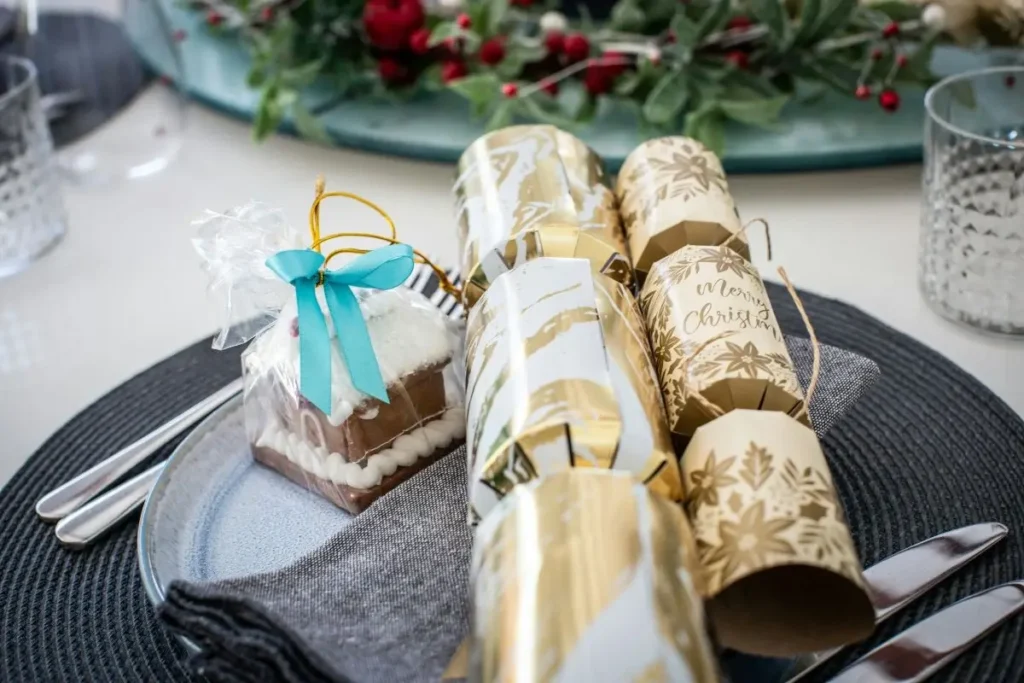
Samples should be reviewed on a representative table, not only in an office. Place the cracker beside the actual or planned plate, glassware, napkin and menu. Check its length, diameter, colour under venue lighting, loose trims and how easily staff can position it. A beautiful oversized cracker may obstruct conversation or be removed before guests arrive.
Test the pull with the intended contents. Record whether the snap operates, whether the gift remains contained, whether the paper tears cleanly and whether the trims shed. If the event includes a coordinated cracker pull, consistency is more important than an elaborate construction.
Plan artwork as event communication
The visual hierarchy should work from seated distance. Decide which element matters most: event identity, host brand, property name, guest name or seasonal pattern. Too many sponsor logos and messages can turn a premium table object into advertising clutter.
- Supply vector logos, colour references and minimum clear-space rules.
- Approve a dieline proof, then a physical print sample under realistic lighting.
- Lock the language, spelling and date before production artwork release.
- Keep warnings, importer details and product identification legible.
- For variable names, approve the data format, missing-name rule, sorting logic and carton labels.
See the custom cracker design workflow for the decisions required before print approval.
Build delivery backwards from the event date
An event date cannot move because a shipment is late. Work backwards from the date the venue needs stock—not from the day guests arrive. Allow time for venue receipt, allocation, inspection and replacement of any transit-damaged units. Earlier in the schedule, reserve time for concept development, gift confirmation, compliance review, samples, artwork approval, production, QC, export documents and freight.
For multi-site orders, decide whether the factory should pack by property, whether a central warehouse will break bulk, and what labels are needed on each carton. Ask the logistics team to confirm delivery access, pallet rules and receiving hours. A container-load programme can protect the product and simplify a large seasonal rollout when carton dimensions and loading are planned with the product.
Calculate quantity without creating an arbitrary percentage
There is no universal “correct” event overage. Calculate reserve stock from actual risks: unconfirmed attendance, number of venues, design personalisation, replenishment time, break-bulk handling and whether damaged packs can be replaced locally. A single-site event with common designs needs a different reserve policy from a named-guest, twenty-property rollout.
Keep three figures in the purchase file: planned place settings, approved operational reserve and total order. If the programme includes multiple SKUs, apply the reserve at the level where substitution is possible. This is more defensible than adding a generic percentage to every design.
Rehearse receiving, allocation and table setup
Large event orders can be correct at factory level and still fail during venue distribution. Mark every master carton with the event or property code, design, quantity, carton sequence and handling orientation. If cartons contain a pre-set mix, print the mix on the label. Provide a packing list that event operations can understand without reference to the factory purchase order.
Before the main event, run a setup rehearsal using a production sample and the intended table instructions. Measure how long staff take to open an inner pack, identify the design, add a place card if required and position the cracker. This can reveal tangled ribbons, unclear labels or excessive individual wrapping while there is still time to adjust the packing method.
Define a quarantine and replacement process for visibly damaged units. Venue teams should know which defects can be corrected on site and which stock should not be used. For multi-day service, record consumption and remaining reserve after each event so allocation can be adjusted rather than discovering a shortage at the final property.
Compare quotations on the complete delivered programme
Compare the same cracker construction, contents, retail or event packing, carton labelling, sample stages, compliance documents, inspection and delivery terms. A quote that excludes property sorting or individual name handling is not directly comparable with one that includes it. Separate one-off artwork, tooling and data-processing costs from repeat unit costs.
Ask for dimensions and carton information as well as unit price. Bulky presentation boxes may affect warehousing, venue handling and freight more than a small factory-price difference. The best-value programme is the one that arrives ready for efficient setup with the agreed guest experience—not merely the lowest number beside one cracker.
Event cracker quotation checklist
- Event type, guest profile and destination market.
- Service date, factory-ready deadline and delivery location or venue schedule.
- Quantity by design, venue and guest group, plus the reserve policy.
- Cracker dimensions, finish, trims, pack format and carton-allocation requirements.
- Gift concept, age grade, safety or food documentation and required warnings.
- Artwork, logos, languages, personalisation file and approval contacts.
- Inspection expectations, shipping terms and required delivery documents.
Request an event-ready sample and delivery plan
JollyCracker manufactures custom party and event crackers for established B2B programmes, including corporate functions, hospitality groups and seasonal venues. We prioritise volume and container-load projects, while the recommended format depends on the contents, retail or event packing, destination and delivery schedule.
Browse the party Christmas cracker manufacturing options, then request factory pricing. Include your guest plan, event date, venue allocation, branding files, gift direction and target market so the first proposal addresses both the table experience and the operational programme.