Novelty Christmas crackers can earn attention without becoming a short-lived gimmick. For a wholesale buyer, the real question is not “Which idea looks funniest?” but “Which concept can be manufactured consistently, passed through the required safety checks, packed efficiently and supported across a full seasonal programme?” This 2026 guide explains how retailers, distributors and established online sellers can build a commercially coherent novelty range rather than buy a collection of unrelated designs.
What “novelty” should mean in a wholesale range
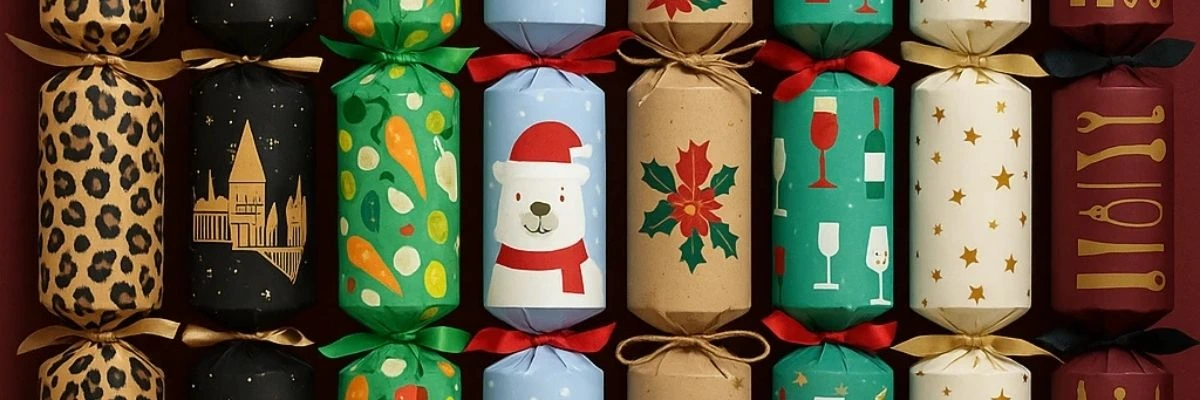
A novelty cracker should have a recognisable reason to exist: a game, audience, occasion, visual story or useful gift. Unusual colour alone is not enough. A strong concept is easy for a buyer to describe in one sentence and easy for a shopper to understand from the front of the retail pack.
For example, “six crackers that create one table quiz” is a complete proposition. So is “a gardening set with six different practical accessories”. By contrast, a box containing unrelated jokes, trinkets and patterns may look varied in a presentation but has no clear shelf message. The creative brief therefore needs to connect the outer artwork, contents, copy, crown and pack structure.
Five scalable novelty directions for 2026
1. Table games with a complete play mechanic
Trivia, charades, conversation prompts and co-operative puzzles work best when all crackers in the box contribute to one experience. Specify the number of players, typical play time, language, answer format and whether replacement cards are required. For international programmes, create separate approved copy files for each language rather than compressing multiple languages into unreadable text.
2. Interest-led gift collections
Gardening, cooking, travel, pets and home-office themes give specialty retailers a clear category story. The gift must still suit the cracker tube and survive packing and transport. Ask for dimensions, weight, material, finish and intended-use information for every item. If the concept needs a custom insert, begin with the custom gifts and fillers programme rather than choosing artwork before the gift has been engineered.
3. Collectable sets
A set of six different ornaments, tokens or character pieces can create a stronger reason to buy the whole box. The commercial risk is uneven assortment. Define whether every retail pack must contain one of each design, whether gifts can be randomised and how the factory will verify the mix. A simple assortment map prevents a good concept becoming a customer-service problem.
4. Occasion-specific crackers
New Year celebrations, winter weddings, corporate dinners and hospitality events can support a more precise proposition than a general Christmas design. The cracker may double as a place card, menu marker or branded guest gift. Event-led buyers should use the dedicated party cracker range; this novelty guide focuses on product concepts intended for repeat wholesale sale.
5. Reduced-plastic novelty
Paper puzzles, wooden tokens, reusable metal accessories and fibre-based decorations can replace generic plastic novelties. Do not treat “plastic-free” as a decorative phrase. Audit the product, window, lamination, ribbon, tray, protective bag and gifts before making the claim. Buyers developing a material-led programme should use the eco-friendly Christmas cracker supplier page, where certification and claim evidence are the primary purchasing criteria.
Novelty does not remove the buyer’s safety responsibilities
The gift determines which rules and tests may apply. A miniature intended for children may be a toy; a food item, cosmetic, battery product or magnet introduces a different compliance route. The target market, age grade and intended use must be agreed before samples are approved.
For Great Britain, the official Toys (Safety) Regulations guidance explains manufacturers’ and importers’ responsibilities, including safety assessment, conformity documentation, traceability and appropriate warnings. In the United States, the Consumer Product Safety Commission’s small-parts guidance explains the restrictions and warning requirements that may apply to children’s products.
Do not accept a supplier statement such as “EN71 material” as the complete evidence pack. Ask which exact item was tested, which age grade and markets are covered, whether the report represents the production material and colour, and how the batch can be traced. Your importer or compliance adviser should confirm the final requirements for the destination market.
Build the design around the retail pack
Novelty ranges often fail at the last stage because the concept was designed as an individual cracker rather than a packaged product. Before artwork sign-off, decide:
- the number of crackers per retail pack and whether the designs are assorted;
- the front-facing message a shopper should understand within seconds;
- whether gifts need to be visible, illustrated or listed;
- the barcode, warnings, importer details and recycling information required;
- the shelf, e-commerce and outer-carton dimensions;
- how the box protects trims, bows and unusual structures in transit.
A window can communicate contents but may add material complexity and reduce printable space. A closed carton can be efficient and premium, but the artwork must explain the novelty. Compare structural routes through JollyCracker’s custom packaging options before finalising the dieline.
Use a sample process that tests the whole proposition
A visual mock-up is useful for colour and hierarchy, but it cannot approve function. Build the sample process in stages: digital concept, blank structure, printed sample, filled pre-production sample and retained production reference. At each stage, record the decision and version number.
Pull several filled samples rather than one presentation sample. Check snap performance, gift insertion, crown and copy, knots or bows, glue marks, abrasion, box closure and assortment accuracy. For game-led products, play the game. For collectables, verify every promised item. For children’s concepts, compare the final sample and warning artwork with the compliance file.
Plan a range, not ten isolated ideas
A container-first programme becomes more efficient when formats share components. A retailer might use one tube size and box footprint across three themes, while changing print, fillers and price position. Common structures simplify tooling, carton planning, quality checks and replenishment discussions. They can also make a mixed-SKU container programme easier to plan than ten unrelated constructions.
Give each SKU a role. One may attract attention, one may offer a family game, one may address a specialist interest and one may provide a higher-value gift. Do not label all of them “best sellers” before the season. Use previous sell-through, returns, reviews and channel-specific data to decide the depth of buy. The separate best-selling cracker range-planning guide explains how to turn those signals into an assortment.
Control licensed themes and intellectual property
Characters, films, sports teams, artists and recognisable brand elements can make a novelty concept immediately understandable, but they also introduce an approval chain. Do not ask a factory to reproduce artwork found online. The buyer should own the design, commission original work with the required rights, or hold a licence that covers the product, territories, channels and selling period.
Put the approval milestones into the production schedule. A rights holder may need to approve concept art, dielines, colour proofs, gifts, packaging copy and production samples. Record who can authorise changes and what happens when a licensed asset is updated after the print deadline. Where the timeline or rights are uncertain, an original theme—such as woodland, astronomy or food—can provide a distinctive range without depending on a third-party release calendar.
Normalise supplier quotations before choosing a concept
A low headline price may exclude the elements that make the idea commercially usable. Create one comparison sheet for paper and finish, gift and individual wrapping, crown and printed content, snap, retail pack, master carton, testing, certification, samples, tooling, inspection and shipping assumptions. Note whether the quote uses the actual assortment or one repeated filler.
Ask the factory to separate fixed development costs from repeat unit costs. This makes it easier to compare a highly original concept with a catalogue adaptation and to understand which cost will disappear on a repeat order. The decision should balance distinctive customer value, evidence, manufacturability and range role—not choose the most complicated sample or the lowest incomplete quote.
Information to put in a novelty cracker brief
- Buyer and channel: supermarket, department store, specialty retail, online or distributor.
- Destination markets: countries, languages and importer requirements.
- Target user: adult, family or a defined child age grade.
- Concept promise: one sentence explaining the novelty.
- Contents: gift specifications, jokes, crowns, game components and assortment rules.
- Product format: cracker size, finish, trims and pack count.
- Evidence: required test reports, declarations, certification and traceability.
- Logistics: launch date, order scale, packing preference, destination and delivery window.
Source a novelty range that can survive the season
JollyCracker develops custom novelty programmes for established B2B buyers, from concept and gift sourcing to retail packaging, production QC and container loading. The most useful first enquiry is not “send your cheapest novelty cracker”; it is a short commercial brief with channel, market, quantity plan, target price position, required delivery date and two or three concept directions.
Review the custom Christmas cracker design process, then request factory pricing and a sample plan. We will recommend which ideas are suitable for a container-load programme and identify the compliance, gift and packaging decisions that need to be resolved before production.