Choose a range buyers can understand, gifts people want to keep, and a specification your market can accept. This 2027 Christmas cracker buying guide is for wholesalers, importers, distributors, retailers and hospitality suppliers planning their next seasonal collection.
The most useful lesson from 2025–2026 is that the gift inside deserves as much attention as the wrapper. Practical mini gifts, shared table games and distinctive keepsakes give buyers a clearer reason to choose one collection over another. At the same time, requests for FSC paper, plastic-free construction and simpler packaging need to become precise product requirements, rather than vague promises on a box.
Research checked: 4 November 2026. The product examples below are mainly UK market observations, with destination-specific regulatory sources. They show what brands offered, not audited global sales. Our 2027 assortment and scheduling recommendations are planning advice, not a forecast or a guaranteed production timetable.
Request Your 2027 Wholesale Range Proposal
In this guide
1. What 2025–2026 tells wholesale buyers
2025: traditional appearance with a more considered gift selection
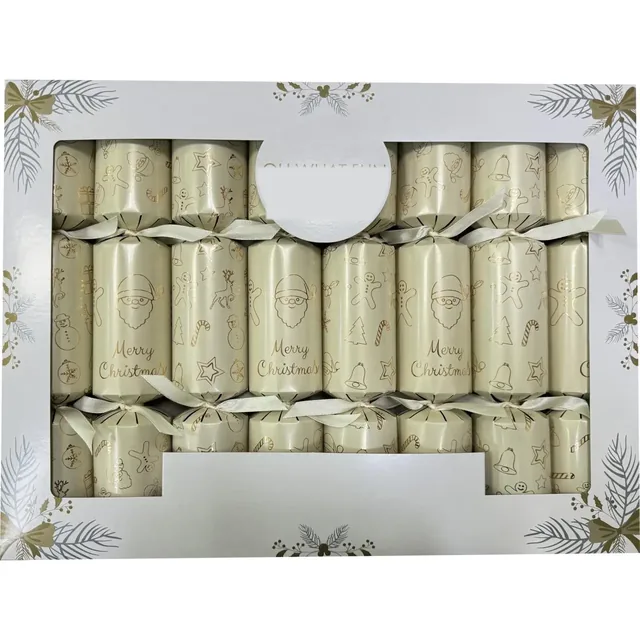
Little Green Cracker Co’s Santa collection is explicitly described as new for 2025. It combines retro festive artwork with a six-piece gift assortment that includes food and personal-care items. This is a useful example of a familiar Christmas look supporting a stronger gifting proposition: customers can understand the occasion immediately, while the contents create a point of difference. It does not prove that food or beauty is the right choice for every export market. Source: Little Green Cracker Co’s 2025 Santa collection.
2027 buying implication: keep recognisable festive designs in the core range, then improve the contents deliberately. A different wrapper on the same undifferentiated filler assortment may create extra stock codes without giving a retailer a convincing reason to carry another line.
2026: practical contents, games and designer keepsakes provide distinct range stories
Talking Tables’ current trade range illustrates two different buying propositions. Partridge & Pear combines illustrated birds and foliage with culinary gifts. Its Nutcracker range combines graphic festive decoration with a Bingo game. Storigraphic’s first cracker collection uses its 2026 designer prints and exclusive wooden pin badges. These are distinct ways to sell the experience inside, rather than relying only on colour or cracker length. Culinary-gift example; Bingo example; designer keepsake example.
2027 buying implication: organise a collection around clear customer benefits: a useful gift, a shared activity, a keepsake or a coordinated premium table. These are development routes supported by observed product offerings; their sales potential still needs to be checked against your accounts, prices and previous sell-through.
2. Christmas cracker styles worth developing for 2027
Updated traditional: the commercial anchor
Red, forest green, ivory, holly, trees, stars, checks and Santa illustrations remain practical starting points for a recognisable Christmas range. Refresh the execution through cleaner drawing, a controlled palette and coordinated ties. Develop two or three complementary prints within one collection, so the box feels intentionally assorted rather than assembled from unrelated leftovers.
For broad wholesale distribution, let the design work across several retail settings. A traditional core collection can suit gift shops, garden centres, department stores and hospitality accounts, with different contents or pack formats where justified. Use your own account history to decide the depth of the order.
Botanical and folk-inspired: decorative, but still festive
Birds, foliage, woodland motifs and illustrated seasonal details offer a route between familiar Christmas decoration and a more distinctive design collection. Use original artwork and a coherent repeat scale. Check how a motif sits on the central barrel after forming: a beautiful flat print can become awkward when an important element disappears into a fold.
Graphic colour: a smaller statement collection
Stripes, harlequins, bold colour blocking and playful Christmas icons can support contemporary gift shops and design-focused accounts. Give this collection a clear role rather than assuming it should replace traditional products. Test the palette against the customer’s tableware, packaging and shelf display. An original pattern can also work across matching gift boxes and seasonal accessories.
Understated luxury: finish, proportion and gift value together
Ivory with gold, rich green, deep red and restrained metallic detail can create a premium direction. The perceived value must continue beyond the outer paper: a well-chosen gift, tidy assembly and a considered presentation box matter. Ask to compare printed metallic effects, selective foil and other finishing options against the budget and material brief. No decorative treatment should be assumed recyclable without checking the finished construction.
Paper-led collections: specify more than a kraft appearance
A natural paper look can communicate the design direction, but brown paper alone does not establish an environmental claim. A strong brief defines the paper, decorations, contents, inserts and outer box. Consider printed decoration, paper ties and window-free presentation where these meet your buyer’s requirements. Explore FSC paper, plastic-free and glitter-free development options.
Protect originality: use market examples to understand a product proposition, then commission your own artwork, game content and gift presentation. Licensed characters, television formats, logos and competitor patterns require the appropriate rights; they are not a shortcut to a private-label range.
3. Which Christmas cracker gifts and fillers should you prioritise?
Start with the recipient and the sales channel, then choose the gift. Check the actual usable internal space, not simply the cracker’s overall length. A long handle, projecting corner or heavy item can change the tube size, protective insert, packing method and freight cost.
First priority: practical mini gifts for adult and mixed-age tables
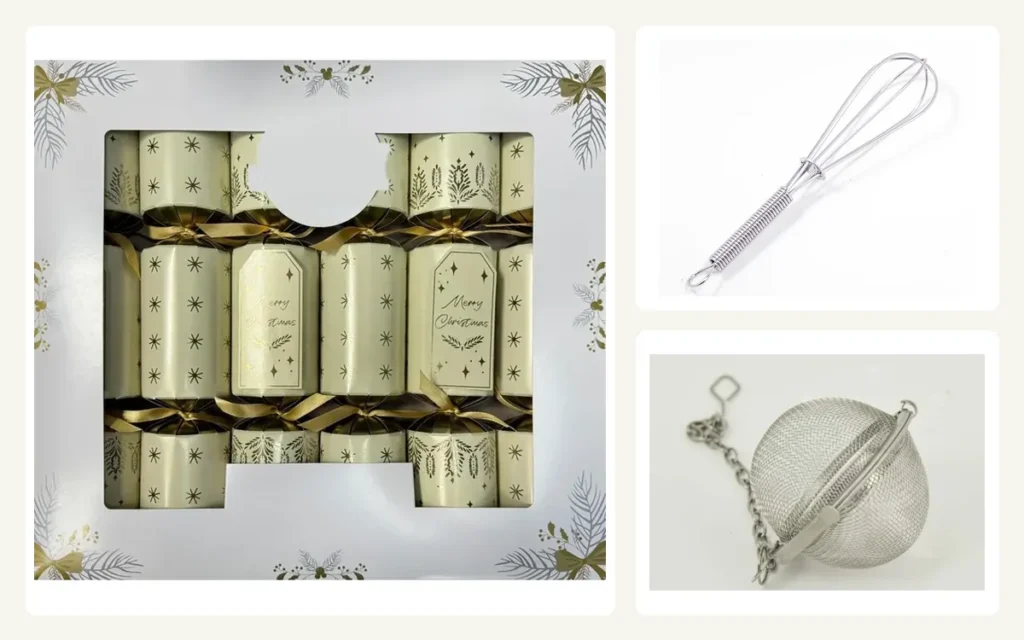
For a broadly accessible adult collection, consider useful kitchen or everyday accessories: small measuring spoons, tea accessories, suitable cookie cutters, mini whisks, bookmarks and selected reusable accessories. Talking Tables’ culinary collection demonstrates the practical-gift proposition; your own selection should be based on fit, finish and target customer rather than copying its assortment.
Review each item in use. Check sharp edges, finish consistency, moving parts and whether it genuinely performs its intended task. Kitchen items may need food-contact documentation appropriate to their material and destination. A metal or wooden item is not automatically suitable simply because it avoids plastic.
Second priority: original paper games and shared activities
Bingo, trivia, conversation prompts, riddles and cooperative challenges can turn a box into a complete table activity. The important buying question is whether the game works for the people at the table. Specify player count, language, reading age, play duration, complete contents and instructions. Test a full set with people who have not seen the instructions before.
For an export collection, localise humour, spelling and cultural references. Keep original content files under version control, so the approved language on the sample matches production. A paper game can reduce dependence on bulky gifts, but any environmental claim still needs a review of the complete set.
Third priority: keepsakes with a coherent collection story
Original wooden decorations, bookmarks, miniature ornaments and selected badges can suit design-led gift retail. Decide whether a box contains all different designs, repeated pairs or a random assortment, then explain it accurately on the pack. If buyers expect six different gifts, production needs a controlled allocation process.
Check attachment strength, surface coating and small-parts risks. Pin badges have sharp points; they should not be treated as a universal family filler. For wood, identify the material and any destination import conditions before buying bulk stock.
Specialist route: beauty, food and buyer-supplied branded gifts
Beauty miniatures, wrapped confectionery and branded merchandise can make a strong gift proposition when the buyer already understands that category. They also introduce additional work: ingredients, allergens, shelf life, batch traceability, leakage, import permissions or cosmetic labelling, depending on the item and market.
Agree who supplies the gift, who checks its documentation and who approves insertion. For buyer-supplied contents, confirm delivery quantities, arrival timing, protective packing and the treatment of damaged or surplus items. The final cracker must be tested with the actual contents, not an empty demonstration shell.
Items to review carefully before adding them
Battery-powered novelties, magnets, sharp tools, fragile glass, liquids, seeds and unprocessed natural materials can add disproportionate complexity. They may still be feasible for a specific programme, but select them only when their customer value justifies the additional checks. An age warning does not replace correct product design and classification.
Explore Gifts & Fillers for Your 2027 Collection
4. Build a wholesale assortment with a clear job for each SKU
A manageable opening range can have a familiar core collection, one practical-gift upgrade and one distinctive game or design collection. This is a starting framework, not a prescribed sales split. Use account commitments, previous stock turnover and margin targets to set quantities.
- Core: recognisable Christmas artwork, a clear contents description and an efficient pack format. Prioritise consistency and dependable repeat supply.
- Upgrade: better presentation plus a meaningful change in gift quality or usefulness. Make the difference visible to the retailer.
- Statement: original games, distinctive artwork or a coordinated keepsake assortment for selected accounts. Start with a quantity supported by customer interest.
For supermarket and department-store programmes, develop artwork, pack size, barcode areas and shelf dimensions together. For independent gift shops, a distinctive story and manageable case quantity may matter more. Hospitality suppliers should confirm table appearance, storage, handling and any venue preference for snap-free products. Corporate buyers need logo approval, recipient suitability and an event delivery plan.
Compare six-piece packs with smaller gifting formats or larger table packs only where the channel supports them. Record both pieces and retail sets: 6,000 crackers packed six per box means 1,000 retail sets, before any agreed spare or inspection allocation. Ambiguous quantity units can distort quotations, carton calculations and delivery expectations.
5. Turn FSC and plastic-free requests into an approved specification
FSC paper: define the scope and documentation
Ask which components are covered: outer wrap, tube, joke card, retail box or other paper parts. Confirm the appropriate supply-chain claim and any intended on-product label before printing. Buying FSC paper does not, by itself, authorise every finished-product claim or use of the FSC logo. FSC explains that finished-product labelling depends on certified supply and approval requirements. Source: FSC on-product labels.
Plastic-free: does it cover the cracker or the complete set?
Write the boundary into the brief. Review the gift, ties, coatings, adhesives, window film, insert, individual wrapping and outer packaging. A paper cracker containing a plastic gift does not meet a complete-set plastic-free brief. A paper-looking ribbon may be a different material; confirm composition rather than relying on appearance.
Glitter-free and recyclability: separate requirements
Glitter-free means avoiding the specified glitter treatment; it does not establish that every other component is recyclable. Recyclability depends on the finished material combination and the destination’s collection and processing arrangements. Ask for component information and proposed disposal wording. Use specific, supportable language rather than broad claims such as “100% sustainable”.
Packaging: keep the retail story while reducing unnecessary material
Compare window-free printed boxes, paper inserts and compact presentation formats. Check visibility, protection, opening experience and how easily components separate. Document packaging weights by material where the importer needs them for reporting. An assembled premium set and a flat-packed kit have different labour, presentation and logistics implications; choose the format with the buyer’s operation in mind.
6. Market rules and policy changes relevant to 2027 orders
The cracker, its snap, the gift and the packaging can each fall under different requirements. The importer should agree the classification and evidence for the exact SKU with the relevant specialist. The following highlights are current planning points checked in November 2026; they are not a complete legal checklist or a guarantee of 2027 clearance.
United Kingdom: packaging costs increasingly reward better design
2025–2026 change: UK packaging extended producer responsibility introduced disposal fees, with modulation by recyclability from the 2026–2027 scheme year. Where the buyer is a liable producer, packaging composition and recyclability can affect its obligations and costs. Request component weights and construction details early enough for the buyer’s assessment. Do not treat a supplier’s “recyclable” statement as the completed assessment. Source: GOV.UK packaging EPR fees and modulation.
Existing requirement, with a proposal to monitor: the UK legislation cited here sets a minimum supply age of 12 for Christmas crackers. A 2026 government consultation proposed removing the purchase-age restriction; a consultation is not a change in law. Recheck the enacted position and territorial scope before approving 2027 retail instructions. A toy filler’s suitability and warnings are a separate question. Age restriction legislation; 2026 consultation.
European Union: packaging and environmental claims need closer attention
2026 change: the Packaging and Packaging Waste Regulation began applying on 12 August 2026, with requirements phased over time. Do not assume every 2030 design or recycled-content target already applies to a 2027 paper gift box. Ask the importer to identify the obligations and transition dates relevant to the actual packaging and destination. National producer-registration and packaging responsibilities also need a market-specific check. Source: European Commission PPWR application notice.
2026 change: the Empowering Consumers for the Green Transition rules apply from 27 September 2026. For 2027 artwork, review environmental language with the importer: generic green claims and sustainability labels face tighter rules. Prefer a precise material statement supported by the appropriate evidence, and avoid implying that one certified paper component establishes the environmental performance of every gift and pack component. Source: European Commission sustainable consumption.
Ongoing requirement: the General Product Safety Regulation has applied since 13 December 2024. Identify the responsible economic operator, traceability and relevant online-offer information where applicable. It does not replace product-specific rules: snaps and toy contents need their own classification review. Plan instructions and warnings for the destination languages before print approval. Source: Commission product-safety guidance.
United States: certification data must be ready before entry where applicable
2026–2027 change: CPSC mandatory eFiling took effect on 8 July 2026 for imported products subject to its certification requirements; the stated effective date for relevant Foreign Trade Zone entries is 8 January 2027. This is not a rule that every paper cracker automatically needs a Children’s Product Certificate. The requirement follows the applicable product rules and certification obligation. Source: CPSC eFiling implementation.
For toys primarily intended for children aged 12 or younger, CPSC explains the applicable third-party testing and Children’s Product Certificate requirements. Match the evidence to the exact filler and age group. Give the importer and broker the approved product identifiers and relevant records before dispatch. Snap classification, transport acceptance and any other federal or state requirements need separate confirmation; a European test report alone does not settle US entry. Source: CPSC toy safety.
Australia: gift choice can create additional obligations
Existing requirements to plan around: Australia has mandatory safety and information standards for button and coin batteries and products containing them. This makes light-up or electronic fillers a more involved choice than an equivalent non-electronic gift. Confirm compliance before supply, not after the range has been printed. Source: ACCC Product Safety.
Wooden and bamboo gifts must meet the relevant BICON import conditions. Food, seeds and other natural-material contents can introduce further biosecurity questions. Use the commercial import conditions for the exact item; personal-luggage guidance is not a commercial shipment approval. The sources reviewed do not establish a new nationwide 2027 requirement that all Christmas bon bons must be FSC or plastic-free. Those may instead be buyer-specific sourcing conditions. Source: Australian Department of Agriculture import guidance.
New Zealand and Canada: do not transfer another country’s approval
For New Zealand, check the EPA rules applicable to the actual Christmas cracker and snap, together with MPI conditions for any biosecurity-risk contents. A product sold in Australia is not automatically approved for New Zealand. Source: New Zealand EPA Christmas crackers guidance.
For Canada, the importer should review the Canada Consumer Product Safety Act, applicable toy or cosmetic rules and required labelling for the selected contents. Health Canada’s guidance makes clear that importers have obligations for commercial consumer products. The reviewed sources do not establish a general new 2027 cracker-specific FSC or plastic-free mandate in either market. Confirm current rules before final artwork and shipment. Source: Health Canada commercial import guidance.
7. A practical 2027 Christmas cracker buying calendar
Work backwards from the date stock must be received, checked and available to sell. A port-arrival date is not a warehouse-ready date. The sequence below is a planning framework; confirm actual sampling, production and freight timing for your order.
- November–December 2026: review 2025 results, gather 2026 account feedback and record early customer interest. Wait for final 2026 sell-through before treating it as a completed season. Shortlist design and gift routes.
- January–February 2027: issue the range brief, agree destination markets and evaluate filler options. Discuss quantities by SKU, material requirements, pack format and the required warehouse date.
- March–April: develop and compare samples. Resolve gift fit, game instructions, artwork, finish and packaging. Identify the applicable testing, evidence and importer responsibilities before locking the specification.
- May–June: target final approvals and purchasing decisions where they suit the agreed receipt plan. Confirm component availability, production allocation, inspection arrangements and shipment booking requirements. Some retailer programmes will need earlier decisions.
- July–September: follow the approved production, inspection and shipping schedule for your destination. Allow for customs, inland delivery and receiving checks; avoid treating this window as a universal safe dispatch deadline.
- October–December: manage replenishment against real stock and feasible freight options. Record defects, customer comments and remaining stock by SKU to improve the next buying cycle.
Ask the supplier to identify decision deadlines separately: artwork freeze, gift approval, packaging approval and shipment readiness. A late change to one component can affect the whole set. Keep a signed approval record for each SKU and agree what happens if a component becomes unavailable.
8. Compare quotations and move from samples to an order
Compare the same finished product
A useful quotation comparison includes the cracker dimensions, exact gift assortment, snap or snap-free format, paper and finish, retail pack, case quantity, carton data and agreed trade term. Separate sampling, tooling, applicable testing, inspection, freight and destination costs. A lower unit price may be offset by a bulky box, omitted contents or additional destination handling.
Review landed cost per sellable retail set, alongside expected wholesale margin and account demand. Avoid relying on a fixed tariff or freight assumption for 2027: the importer and broker should check the classification, origin and current charges when booking.
Approve a complete sample
Pull the cracker, inspect the gift, read the instructions and repack the complete set. Check artwork alignment, ties, component fit, gift allocation and box protection. Review the relevant material and product evidence against the approved specification. Keep a reference sample and identify acceptable tolerances and inspection points in the order documents.
Put the agreed decisions into the purchase order
Record the SKU quantities, pack configuration, artwork version, contents list, required documentation, approval reference, delivery terms and change-control process. Agree inspection responsibilities, defect handling and remedies commercially before production. Do not let an attractive sample stand in for a clear order specification.
9. Questions wholesale buyers ask
Which filler direction should we sample first?
For an adult table-gifting collection, start by comparing a practical-gift assortment with an original paper-game set. Add a keepsake line if it fits your accounts. Food, beauty and electronic gifts are better treated as specialist programmes with the relevant category review.
Can we develop an FSC-paper and plastic-free range together?
Yes, those requirements can be included in the same development brief. Confirm each claim’s scope and supporting documentation separately. FSC addresses the relevant forest-based material supply chain; it does not establish that every component is plastic-free or recyclable.
Can the cracker and retail box carry our own design?
JollyCracker supports custom artwork, selected gifts and coordinated packaging development for wholesale programmes. Send your original artwork or visual direction and tell us the intended market. Final materials, claim wording and product details are confirmed during development.
What quantity should we send for an initial enquiry?
Send an estimated total and, if available, the split by design and retail pack. State whether the number means individual crackers or boxed sets. If your range is still being planned, share the intended channel and quantities under consideration so we can discuss a suitable supply format.
Develop your 2027 wholesale collection with JollyCracker
Bring us the range you want to sell: familiar festive designs, premium presentation, practical gifts, original paper games or an FSC-paper and plastic-free brief. We can help coordinate the cracker, selected contents and packaging around your requirements, with the specification and commercial details confirmed directly for your project.
Start with your destination country, estimated quantity and required delivery period. Add the styles or gift directions you prefer, your sales channel and any material priorities. If you already have artwork, a retailer brief or buyer-supplied gifts, tell us about them.
Request a 2027 Wholesale Quote & Sample Discussion
Or email [email protected] with your buying brief. Explore our Christmas cracker collections, gift and filler options and production capabilities while planning your order.