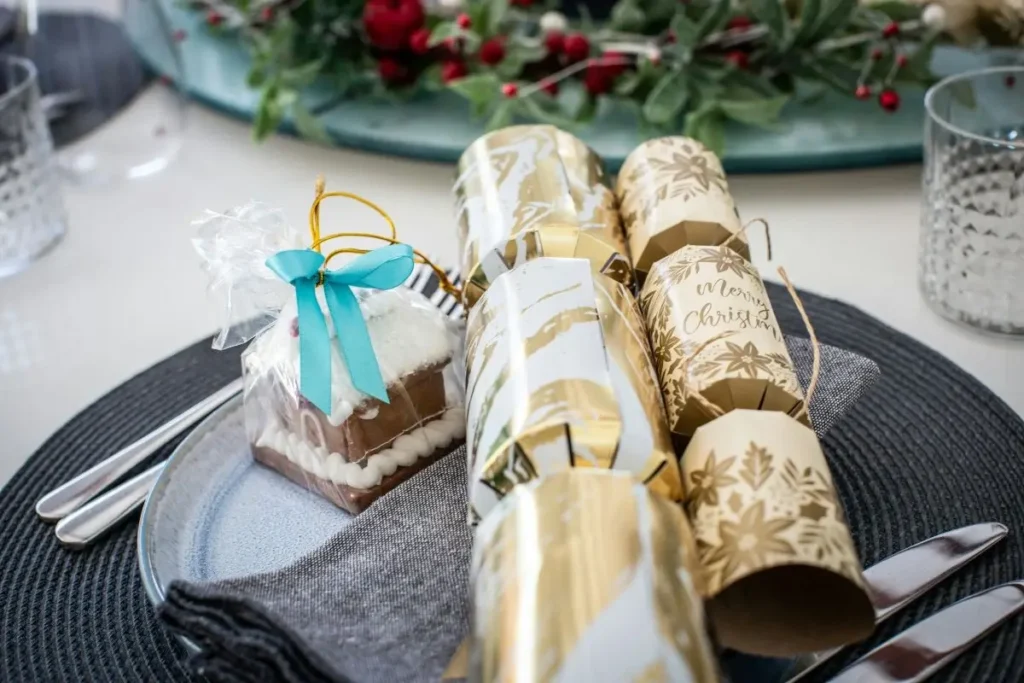
Christmas crackers can do more than decorate a table. For a well-planned business campaign, they can combine branded packaging, a physical interaction and a useful gift in one shared moment. The important word is planned: putting a logo on a generic cracker is not automatically an effective marketing idea.
This guide explains how marketing teams, corporate buyers, hospitality groups and agencies can develop Christmas crackers for marketing without relying on invented reach figures or vague promises. It covers the campaign brief, design choices, gift sourcing, distribution and measurement that should be agreed before production begins.

Where Christmas crackers fit in a business campaign
A cracker works best when it has a clear job. The same construction can support several objectives, but the specification should change with the audience and setting.
- Client gifting: a presentation box containing crackers designed for a client’s Christmas table, often accompanied by a message card or other seasonal gift.
- Corporate events: branded crackers placed at a dinner, awards evening or staff celebration, with content linked to the event theme.
- Hospitality: crackers specified for hotels, restaurants, clubs or cruise operators, where table space, service speed and guest safety all affect the format.
- Retail campaigns: own-brand or exclusive crackers sold as seasonal merchandise, rather than given away as promotional items.
- Employee engagement: crackers distributed at a workplace celebration or included in a seasonal care package, with inclusive and audience-appropriate contents.
Trying to serve all five uses with one design usually produces compromises. A retail pack needs shelf information and barcode planning; an event cracker may need place names or table-specific inserts; a client gift needs protective presentation packaging. Define the use case before discussing colours and finishes.
Start with a campaign and procurement brief
A useful brief lets a manufacturer assess feasibility instead of guessing. Include the following information at the enquiry stage:
- campaign objective and intended recipient;
- destination markets and required delivery date;
- estimated quantity and whether distribution is to one warehouse or several addresses;
- preferred cracker size, retail or presentation pack, and display requirements;
- brand artwork, approved colours, logo rules and mandatory legal copy;
- gift category, target value, age suitability and restricted materials;
- environmental requirements that can be supported by evidence;
- approval contacts and the date by which artwork and samples must be signed off.
If the project is still exploratory, separate the “must have” elements from the options. This gives the supplier room to propose a construction and packing plan that fits the budget and shipping route. JollyCracker’s custom Christmas cracker process shows the main decisions that move a concept towards a production-ready specification.
Design every touchpoint, not only the barrel
The visible paper barrel is one branding surface, but the complete experience includes the outer pack, closure, snap, paper crown, motto, gift and any inserted card. Decide which element carries which message.
Keep the exterior recognisable
Use brand colours and visual assets consistently, but leave enough contrast for the logo and required information. Fine detail, pale type and designs that depend on a screen effect may not reproduce well on textured or metallic papers. Ask for a printed sample or colour proof when exact reproduction matters.
Give the inside content a purpose
A generic trinket can weaken a premium campaign. A better choice relates to the recipient or occasion: a practical travel item for a hotel loyalty programme, a themed keepsake for an event, or a small product connected to the company’s service. Custom gifts require earlier feasibility checks because dimensions, weight, material and packing method affect the cracker structure. Review the custom gifts and fillers options before finalising artwork around an untested object.
Use QR codes as a bridge, not a decoration
A QR code can lead to event content, a campaign landing page, a redemption form or a product story. Give the recipient a reason to scan it, keep the destination mobile-friendly and test the printed code at final size. Avoid placing the only code across a fold or highly reflective area. If the destination may change, use a managed redirect that the marketing team controls.
Plan the unboxing, distribution and table experience
A marketing team may approve the appearance while overlooking how the crackers reach recipients. Ask practical questions before the packing specification is locked:
- Will cartons go to one distribution centre, individual venues or a fulfilment partner?
- Does each case need an event, branch or recipient identifier?
- Must the retail pack stand, hang or fit a fixed shelf depth?
- Will crackers arrive assembled, or is a project-specific flat-packing plan being considered?
- Who is responsible for final-mile delivery, and what protection does that route require?
These decisions affect carton size, labour, damage risk and warehouse handling. For international projects, compare the options in the packing and shipping guide before treating freight as a final quotation line.
Make environmental claims specific and supportable
Words such as “green”, “sustainable” and “eco-friendly” are too broad unless the claim explains what has changed and can be evidenced. The UK Competition and Markets Authority’s Green Claims Code asks businesses to make claims that are clear, accurate and not misleading.
For a cracker campaign, a useful brief might specify FSC-certified paper options, reduced plastic content, a paper-based gift or packaging designed without a plastic window. Confirm the scope of any certification and keep supplier records. Do not imply that the entire product has an environmental benefit when the evidence applies only to one component. JollyCracker’s eco-friendly cracker options can be discussed component by component.
How to measure a Christmas cracker marketing campaign
Measurement should follow the campaign objective. A cracker does not need an invented “cost per impression” to prove its value. Choose a small set of observable outcomes and establish the baseline before distribution.
| Campaign use | Possible measure | Collection method |
|---|---|---|
| Client gifting | Delivery completion, response and qualified follow-up | CRM campaign field and account-team notes |
| Event | Participation, scans or content downloads | Event count and tracked QR destination |
| Retail product | Sell-through, returns and stock remaining | SKU-level sales and inventory data |
| Promotion | Code redemption or landing-page action | Unique code and analytics event |
| Employee programme | Distribution completion and feedback | Internal survey with a defined response window |
For links, Google Analytics documents the use of UTM campaign parameters to identify referring campaigns. Use a consistent naming convention and test the complete printed journey before production. Do not put personal data into the URL. QR scans alone are an interaction count, not proof of a sale or a change in brand preference, so report each measure for what it actually represents.
A realistic B2B production workflow
Custom cracker projects usually move through briefing, quotation, structural confirmation, artwork, sampling or proofing, approval, production, quality control, packing and dispatch. Gift sourcing and bespoke packaging add dependencies. A change to the gift can alter the barrel diameter; a change to the retail pack can alter the master carton; a late artwork revision can affect every subsequent approval.
Build backwards from the required in-warehouse date, not the event date. Include time for internal brand approval, sample transit, production inspection, international freight, customs and local distribution. The manufacturer should confirm a schedule for the actual specification rather than promise a universal lead time.
Questions to ask a Christmas cracker marketing supplier
- Which parts of production and quality control are handled in-house?
- Can the structure be tested with the intended gift before artwork approval?
- What proof, sample and approval stages are included?
- How are colours, snap performance, contents and pack quantities checked?
- Which test reports, declarations or material records are relevant to the destination market?
- How will cartons be marked for the buyer’s warehouse or event network?
- What happens if the artwork, gift or delivery plan changes after approval?
Examples of completed specifications are more useful than anonymous praise. Review JollyCracker’s buyer project examples to see how quantity, packaging, timing and outcome can be documented.
Turn the idea into a production-ready campaign
Christmas crackers for marketing are strongest when the physical product, message and measurement plan are designed together. Begin with the recipient and campaign objective, then agree the gift, construction, evidence-based claims, packing and distribution route. The result is a useful branded experience rather than simply another item carrying a logo.
Planning a corporate, hospitality or agency programme? Send JollyCracker your campaign brief, including destination, timing, quantity range, brand requirements and gift idea, for a project-specific manufacturing and packing review.